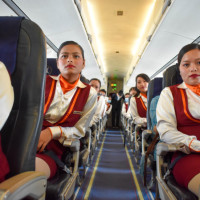
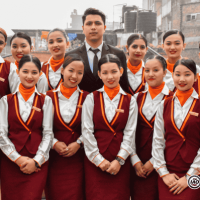
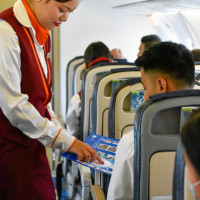
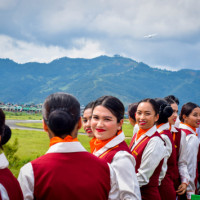
.png)
Nepal's cabin crew industry is growing rapidly. Over 2,000 Nepali flight attendants are currently working with international carriers including Emirates, Qatar Airways, and Singapore Airlines — and demand for qualified, professionally trained candidates continues to rise every year. Whether your goal is a domestic career with Yeti Airlines or Buddha Air, or an international role with a Gulf carrier, this guide covers everything you need to know: eligibility criteria, the best training programmes, fees, realistic 2026 salary expectations, and how to choose the right institute.
What Is an Air Hostess / Cabin Crew Member?
Quick Answer
An air hostess, also called a flight attendant or cabin crew member, is a trained aviation professional responsible for the safety, comfort, and well-being of passengers on commercial, charter, or military flights.
The primary role of a cabin crew member is passenger safety — not simply serving meals and beverages. Cabin crew are trained professionals qualified in emergency evacuation procedures, firefighting, first aid, ditching and water survival, and conflict de-escalation. Customer service is the visible part of the job; safety management is the foundation.
In Nepal, air hostesses serve both domestic routes (Kathmandu–Pokhara, Kathmandu–Bhairahawa, Kathmandu–Biratnagar on ATR 72s, Twin Otters, and Beech Aircraft) and international routes on Airbus and Boeing aircraft with carriers like Himalayan Airlines and international employers abroad.
📎 Related: How to become internation air hostess in nepal — a dedicated guide covering international airline requirements and career paths.
How to Become an Air Hostess in Nepal
Quick Answer
Complete 10+2 from any faculty, enrol in a CAAN/ICAO/IATA-certified training programme (3–4 months), gain in-flight practical experience, and apply directly to airline vacancies with placement support.
Becoming a cabin crew member in Nepal is a structured process. Unlike some countries that require a university degree, Nepal's aviation regulator — the Civil Aviation Authority of Nepal (CAAN) — requires only 10+2 completion for domestic airline eligibility and similar academic standards for international programmes.
- Meet the eligibility criteria — See the full checklist in the next section.
- Enrol in a certified training institute — Choose a CAAN-approved programme aligned to ICAO and IATA standards for international opportunities.
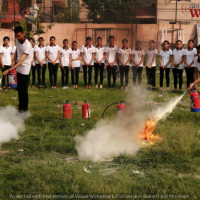
- Complete 3–4 months of classroom and practical training — Modules include emergency procedures, safety equipment, passenger handling, grooming, communication, and food and beverage service.
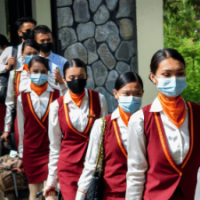
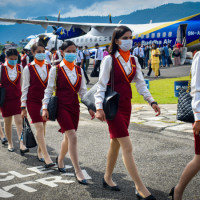
- Participate in supervised in-flight training — Institutes like Global Wings include an actual flight (Kathmandu–Pokhara on an ATR 72/bombadier ) as part of the curriculum so students experience real cabin crew duties at altitude before entering the job market.
- Apply to airline vacancies — With placement assistance from your institute, apply to domestic and international carriers.
- Clear the airline selection process — Written test, group discussion, personal interview, medical clearance, and background check.
The full process from enrolment to first job placement typically takes five to eight months, including training and job application lead time.
Watch: Inside Global Wings Air Hostess Training
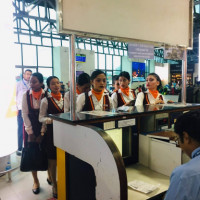
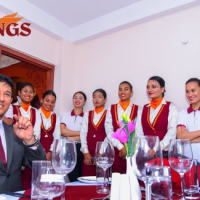
See how students are trained through real classroom instruction, grooming labs, emergency procedure sessions, interview preparation, and actual in-flight practical experience at Global Wings Aviation Academy in Kathmandu.
Air Hostess Eligibility Requirements in Nepal (2026)
Quick Answer
You need to have passed 10+2 (any faculty), be aged 18–28, meet height and BMI standards, be medically fit, and be unmarried. Both men and women are eligible to apply.
Eligibility requirements vary slightly between airlines, but the following are the standard criteria across Nepal's aviation sector in 2026:
| Requirement | Domestic Airlines | International Airlines |
|---|---|---|
| Education | 10+2 passed (any faculty) | 10+2 passed (any faculty) |
| Age | 18–26 years | 18–28 years |
| Height (Female) | Minimum 157 cm (5.2 ft) | Minimum 157–160 cm |
| Height (Male) | Minimum 170 cm (5.7 ft) | Minimum 170 cm |
| Vision | 6/6 or 6/24 (contact lenses accepted) | 6/6 or 6/24 (contact lenses accepted) |
| BMI | Normal range | Normal range |
| Marital Status | Unmarried | Unmarried (most carriers) |
| Language | Nepali + English proficiency | Fluent English; additional language is an advantage |
| Documents | Nepali citizenship | Nepali citizenship + valid passport |
| Medical | Full medical clearance required | Full medical clearance required |
Medical tests conducted by airlines typically include blood and urine tests, an eye test, an ECG/heart test, chest X-ray, and a general physical examination. The training itself also includes a fitness component — students must be able to swim, which is tested in the ditching and water survival module.
📎 Check your eligibility now: View full eligibility criteria on our course page — including current intake dates and batch schedules.
What Air Hostess Courses Are Available in Nepal?
Quick Answer
Nepal's training institutes offer three main programmes: a 3-month Basic Course (domestic airlines), a 4-month Diploma Course (international airlines), and an Advanced Combined Course covering both cabin crew and ground handling.
Air hostess training in Nepal is offered at three levels, each targeting a different stage of aviation career ambition:
1. Basic Cabin Crew Course (3 Months)
Designed for students aiming to work with domestic Nepali airlines. Training follows the CAAN (Civil Aviation Authority of Nepal) curriculum. Suitable for aircraft types including Dornier, Twin Otter, Beech Aircraft, Jet-Stream, and ATR.
Modules covered: Personality development, communication skills, aviation product knowledge, firefighting, swimming and ditching, self-defence, make-up and grooming, in-flight service, and basic ticketing.
2. Diploma / Advanced Cabin Crew Course (4 Months)
The flagship programme for students targeting international airline careers — including Gulf, Asian, and European carriers. Follows ICAO, IATA, and CAAN curricula. Covers wider aircraft types: ATR, CRJ, Airbus A320/A330, Boeing 737/777.
Additional modules include: Safety Management System (SMS), Crew Resource Management (CRM), Dangerous Goods Regulations (DGR), food and beverage service, advanced English communication, and mock airline interviews.
3. Advanced Combined Course (Cabin Crew + Ground Handling)
For students who want broader aviation career options. Combines cabin crew training with ground handling and airport operations — opening doors to roles in airport management, check-in operations, and cargo handling in addition to in-flight positions.
📎 Compare courses in detail: Full course breakdown with fees, duration, and enrolment.
How Long Is Air Hostess Training in Nepal?
Quick Answer
Air hostess training in Nepal takes 3 months (Basic Course) or 4 months (Diploma/International Course), followed by in-flight practical experience. Total time from enrolment to job readiness is approximately 5–8 months.
Training duration depends on the course level chosen. The Basic Course runs for 3 months with a curriculum designed around CAAN requirements for domestic airline service. The Diploma Course runs for 4 months and includes additional international airline modules such as CRM, SMS, and DGR.
At Global Wings, training includes a unique component that most institutes do not offer: a real in-flight experience on a commercial domestic flight (typically Kathmandu–Pokhara on an ATR 72 aircraft). Students participate as cabin crew observers alongside qualified airline crew — gaining firsthand experience of pre-flight safety checks, cabin announcements, meal service, and emergency equipment locations before they ever apply for a job.
Air Hostess Course Fees in Nepal (2026)
Quick AnswerAir hostess training in Nepal costs between NPR 29,000 and NPR 45,000 depending on the course level. Global Wings' Basic Course starts at NPR 29,000, and the Diploma/International Course is priced higher. Fees include study materials, uniform, grooming sessions, and in-flight experience.
| Course | Duration | Fee Range (NPR) | Suitable For |
|---|---|---|---|
| Basic Cabin Crew | 3 months | 29,000 – 32,000 | Domestic airlines |
| Diploma Cabin Crew (International) | 4 months | 35,000 – 45,000 | International airlines |
| Advanced Combined Course | 4–5 months | 40,000 – 50,000 | Cabin crew + ground handling careers |
Fees at quality institutes typically include study materials, training uniform, grooming and make-up sessions, swimming pool access (for ditching module), first aid kit, and the in-flight practical experience. Always confirm exactly what is included before enrolling.
Fee Tip: Global Wings periodically offers discounts for early enrolment and batch promotions. Contact our admissions counsellor on 9843266787 or info@globalwings.com.np for current offers and upcoming batch dates.
Air Hostess Salary in Nepal (2026)
Quick Answer
In 2026, domestic airline cabin crew in Nepal earn NPR 40,000–75,000 per month. International airline positions offer NPR 199,500–465,500+ per month, depending on the carrier and route.
Salary for cabin crew in Nepal varies significantly based on the airline, aircraft type, route, and years of experience. Here is the current salary landscape in 2026:
| Category | Experience Level | Monthly Salary (NPR) |
|---|---|---|
| Domestic Airline (Entry) | 0–1 year | 40,000 – 55,000 |
| Domestic Airline (Senior) | 2+ years | 60,000 – 75,000 |
| International Airline (Entry) | 0–2 years | 199,500 – 280,000 |
| International Airline (Mid-Senior) | 3–5 years | 280,000 – 465,500+ |
Beyond base salary, cabin crew often receive flight hour allowances, layover allowances, meal allowances, accommodation on layovers, health insurance, and annual travel benefits. For international positions — particularly with Gulf carriers — the total compensation package often includes tax-free salary and accommodation.
📎 Detailed salary breakdown: International Cabin Crew Salary in Nepal 2026 — covers airline-by-airline pay scales, allowances, and career progression.
Is Air Hostess a Good Career in Nepal in 2026?
Quick Answer
Yes — cabin crew is one of Nepal's most sought-after aviation careers in 2026. The sector is growing, international opportunities are expanding, and over 2,000 Nepali cabin crew are already working globally. It offers competitive pay, travel, and professional growth.
Nepal's domestic aviation sector continues to expand. Tribhuvan International Airport in Kathmandu handles growing passenger volumes each year, and new airlines and routes regularly enter the market. At the same time, the international pathway — particularly through Gulf carriers and Asian airlines — has made aviation one of the highest-paying sectors for young Nepali professionals without a university degree.
That said, cabin crew is a demanding career. It involves irregular duty hours, international time zone shifts, physical fitness requirements, and the ongoing pressure of managing passenger safety and service simultaneously. The journey requires patience, professionalism, and genuine commitment.
Who is this career best suited for?
People who:
- Enjoy meeting people from diverse backgrounds and cultures
- Want to travel as part of their working life
- Thrive in a fast-paced, dynamic environment
- Are comfortable working non-standard hours
- Have strong communication skills in English and Nepali
- Take pride in personal presentation and professionalism
Which Airlines Hire Cabin Crew Trained in Nepal?
Quick Answer
Nepal-trained cabin crew are hired by domestic carriers including Yeti Airlines, Buddha Air, Shree Airlines, Himalayan Airlines, and Shaurya Airlines, as well as international carriers such as Emirates, Qatar Airways, and Singapore Airlines.
Domestic Airlines
- Yeti Airlines — One of Nepal's largest domestic carriers; regularly recruits fresh cabin crew
- Buddha Air — Major domestic operator; known for structured cabin crew development
- Shree Airlines — Growing domestic network with regular crew recruitment
- Himalayan Airlines — Nepal's international flag carrier operating international routes
- Shaurya Airlines — Domestic operations with regular cabin crew vacancies
International Airlines (Recruiting Nepali Cabin Crew)
- Emirates (Dubai)
- Qatar Airways (Doha)
- Singapore Airlines
- Various Gulf and Asian regional carriers
📎 Latest vacancies: Nepal Airlines Cabin Crew Requirements and Application Process — current eligibility and how to apply.
Top Air Hostess Training Institutes in Nepal
There are several recognised training institutes across Nepal's major cities including Kathmandu, Pokhara, Chitwan, Butwal, and Bhairahawa. When evaluating an institute, look for CAAN/ICAO/IATA accreditation, experienced instructors with real airline backgrounds, and verifiable placement records.
| Institute | Location | Key Strength |
|---|---|---|
| Global Wings Pvt. Ltd. | Putalisadak, Kathmandu | CAAN standard-based curriculum; real in-flight training; 13+ years |
| Flytech Airhostess Training | Kathmandu | Established domestic training programme |
| Air Hostess Training Institute Pvt Ltd | Kathmandu | Standard CAAN-aligned curriculum |
| Geeta Aviation | Kathmandu | Entry-level cabin crew training |
When choosing an institute, the most important factors to verify are: (1) CAAN/ICAO/IATA alignment for international ambitions, (2) whether real in-flight practical training is included, (3) the credentials and airline experience of instructors, and (4) documented placement rates and alumni in active airline roles.
Why Global Wings Is Nepal's Leading Air Hostess Training Institute
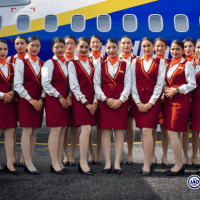
Global Wings Pvt. Ltd. has been training cabin crew professionals since 2012 — over 13 years of continuous operation from its Putalisadak, Kathmandu campus. The institute is a quality-assured aviation academy and offers curricula fully designed around global standards, matching the training blueprints of international networks.
What sets Global Wings apart:
- Real in-flight practical training — the only institute in Nepal offering a supervised domestic commercial flight as part of the standard curriculum
- Global standard curriculum — structured to meet the entry criteria of both domestic and international airlines
- Experienced instructors — faculty with active airline industry backgrounds, not just classroom trainers
- Industry recognition — Asia's Best Organisation Award for Women Talent Development 2020/2021; Outstanding Vocational Training Institute award
- Placement support — active vacancy notification for all graduates; alumni placed at Yeti Airlines, Buddha Air, Shree Airlines, Himalayan Airlines, Shaurya Airlines, and international carriers
- Small batch sizes — individual attention and targeted feedback rather than mass-throughput training
📎 Learn more about Global Wings' history, certifications, and awards — including our Internationally benchmarked training, license numbers, and student outcome data.
Frequently Asked Questions
Q. What is the best air hostess training institute in Nepal?
A.Global Wings Pvt. Ltd. is widely recognised as Nepal's No.1 air hostess training institute. It has operated since 2012, quality-assured aviation academy, and offers ICAO/IATA/CAAN-certified courses from Putalisadak, Kathmandu. Other recognised institutes include Flytech Airhostess Training, Air Hostess Training Institute Pvt Ltd, and Geeta Aviation.
Q. How much does air hostess training cost in Nepal?
A.Air hostess training in Nepal costs between NPR 29,000 and NPR 50,000 depending on course level. Global Wings' Basic Course starts at NPR 29,000 (3 months, domestic-focused) and the Diploma/International Course is higher. Fees typically include study materials, uniform, grooming, and in-flight practical experience.
Q. What are the eligibility requirements for air hostess training in Nepal?
A.You need to: (1) have passed 10+2 in any faculty; (2) be aged 18–28 years; (3) meet minimum height — 157 cm for females, 170 cm for males; (4) have normal BMI; (5) have 6/6 or 6/24 vision (corrected lenses accepted); (6) be unmarried; (7) be proficient in English and Nepali; (8) hold or be eligible for a Nepali passport for international roles.
Q. What is the air hostess salary in Nepal in 2026?
A.In 2026, domestic airline cabin crew earn approximately NPR 40,000–75,000 per month. International airline positions offer NPR 199,500–465,500+ per month. Salary depends on airline, route network, aircraft type, and experience level. Gulf carriers typically offer the highest packages.
Q. How long is air hostess training in Nepal?
A.Training takes 3 months (Basic/domestic course) or 4 months (Diploma/international course). Total time from enrolment to job readiness — including the application process — is typically 5–8 months.
Q. Is air hostess a good career in Nepal in 2026?
A.Yes. Aviation is a growth sector in Nepal and internationally. Over 2,000 Nepali cabin crew are currently working with global airlines. The career offers competitive pay, travel, professional development, and flexibility — though it requires irregular hours, physical fitness, and strong communication skills.
Q. Can men become cabin crew in Nepal?
A.Yes. Cabin crew careers in Nepal are open to both men and women. Male candidates need a minimum height of 170 cm and must meet the same academic, medical, and language requirements as female applicants. All Global Wings courses welcome male students.
Q. What courses are available in air hostess training in Nepal?
A.Three main programmes: (1) Basic Cabin Crew Course — 3 months, CAAN-aligned, domestic airline focus; (2) Diploma Cabin Crew Course — 4 months, ICAO/IATA/CAAN-aligned, international airline focus; (3) Advanced Combined Course — cabin crew plus ground handling, broadest career options
Q. Which airlines hire cabin crew trained in Nepal?
A.Domestic: Yeti Airlines, Buddha Air, Shree Airlines, Himalayan Airlines, Shaurya Airlines. International: Emirates, Qatar Airways, Singapore Airlines, and various Gulf and Asian carriers. ICAO/IATA-certified training significantly improves international placement chances.
Q. What subjects should I study to become an air hostess?
A.No specific 10+2 subject is mandatory. Any faculty qualifies. During training, you will study aviation safety, emergency procedures, passenger service, grooming, English communication, food and beverage service, and basic ticketing. Hospitality, English, or science backgrounds are an advantage.
.png)
.png)
.png)